
Updated: July 26, 2026
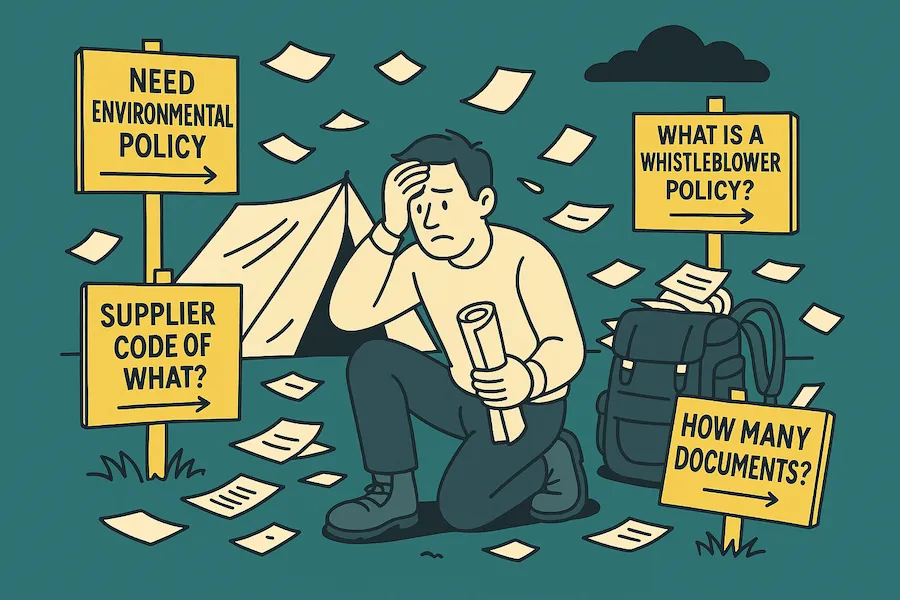
Facing your first EcoVadis assessment can feel overwhelming, especially when you realise you may need to begin writing EcoVadis policies before you submit. Policy writing is a pain point for many teams. It can feel like standing at the bottom of the mountain, surrounded by half-finished documents, old procedures and a customer deadline. This guide helps you identify the essential sustainability policies that can form your first EcoVadis policy foundation.
But first, the basics. EcoVadis policy requirements are not a fixed list of six PDF files. EcoVadis customises the questionnaire based on your company context, so the same policy set will not fit every company. The six policy foundation areas below give you a practical starting map before you start uploading evidence or adapting any EcoVadis templates.
Quick answer: Which policies do you need for EcoVadis?
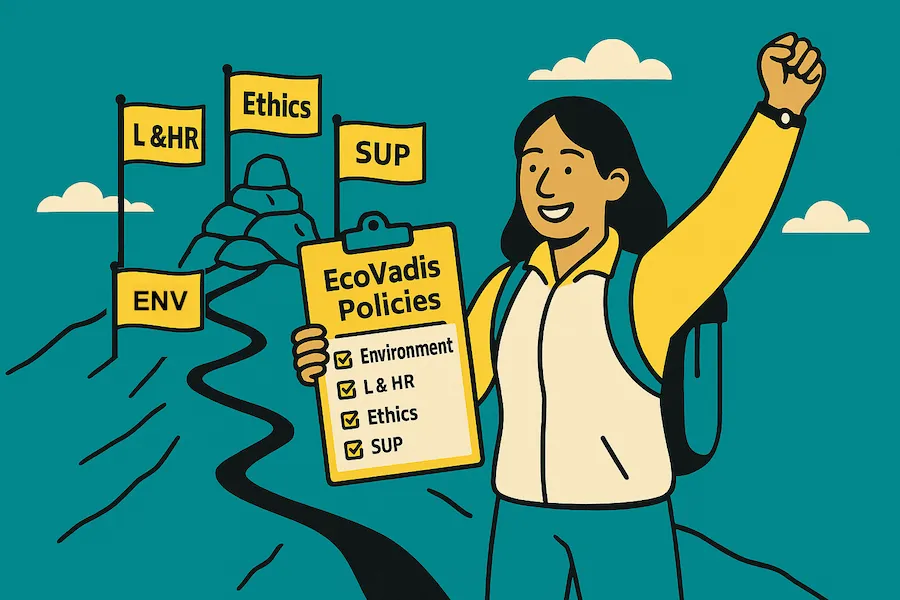
Most companies should start by checking six policy foundation areas: Environment, Labour and Human Rights, Health and Safety, Equal Opportunity, Ethics and Business Conduct, and Sustainable Procurement or supplier expectations. These are not the only possible EcoVadis policies, but they are a useful first set of essential sustainability policies. Depending on your questionnaire, those foundations may need supporting documents such as anti-corruption, whistleblower, data protection, sustainability governance or product stewardship policies.
- Your exact policy needs depend on your activated criteria, scope, size, industry and locations.
- A policy should show commitments, ownership, scope, review and management approval.
- EcoVadis policy templates can help you move faster. Generic, unadapted EcoVadis templates are weak evidence.
- Policies are only the foundation. EcoVadis also looks for actions, coverage, reporting and other evidence.
Free EcoVadis Assessment Start Pack
Check whether policies are really your first priority
Before you start drafting more documents, confirm where the biggest preparation gap actually sits. The Assessment Start Pack helps you check your starting position, organise internal requests and begin mapping the documents you already have.
Before you dive in, a quick note on teamwork: creating and gathering these documents is rarely a one-person job. You will likely need to collaborate with colleagues from several departments, including:
- Human Resources: For policies related to labour and human rights, health and safety, equal opportunity and employee training.
- Procurement: For your Supplier Code of Conduct and Sustainable Procurement policy.
- Legal and Compliance: For your Code of Ethics, anti-corruption policy, whistleblower policy and data protection.
- Operations or Facilities: For environmental impacts, health and safety controls and operational procedures.
Building these relationships early will make the entire EcoVadis process much smoother.
Quick Navigation
- 1. Why Policies are Your EcoVadis Starting Point
- 2. What Are the 6 EcoVadis Policy Foundation Areas?
- 3. Policy, Code, Procedure or KPI: What Are You Uploading?
- 4. What Belongs in an EcoVadis Environmental Policy?
- 5. What Belongs in an EcoVadis Labour and Human Rights Policy Stack?
- 6. What Policies Form a Strong EcoVadis Code of Conduct and Ethics Framework?
- 7. Why is an EcoVadis Supplier Code of Conduct Essential?
- 8. Beyond the First Six: Supporting Policies That May Matter
- 9. How Can We Create Effective Policies Quickly?
- 10. EcoVadis Policy FAQ
Why Policies are Your EcoVadis Starting Point
Policies show your company’s intent, governance and commitments. They are part of the Policies, Actions and Results (P-A-R) logic that EcoVadis uses to assess the quality of a sustainability management system. EcoVadis describes its methodology as measuring sustainability management through three pillars, split into seven management indicators, including Policies. For the deeper scoring explanation, read the EcoVadis methodology guide or EcoVadis’ own methodology overview.
What Comes After Policies?
Policies are the beginning of the management-system story. To support a stronger assessment, they need to connect to two other layers:
- Actions: The concrete steps you take to implement your policies, such as training, procedures, risk assessments, audits or certifications.
- Results: The KPIs and data that show whether the actions are tracked, such as GHG emissions, injury rates, training completion or supplier sign-off.
EcoVadis supporting documents should be formal, recent and pre-existing evidence of the management system. EcoVadis guidance also explains that supporting documents should be reviewed regularly, with an 8-year validity period for policies and actions and 2 years for KPI reporting in the standard document rules. You can check the latest EcoVadis wording in its supporting documents guidance.
For policy evidence, focus on whether the document is:
- Relevant: It addresses your company’s impacts and the activated criteria in your questionnaire.
- In scope: It applies to the assessed entity, locations, workforce, operations or supplier base you are being assessed on.
- Current: It has a clear issue, approval or effective date, is reviewed regularly and is version-controlled.
- Credible and official: It is clearly attributable to your company, approved or endorsed by management and has a real owner.
- Connected: It links to actions, controls, communication, training or reporting evidence you can show elsewhere.
Beyond your documentation, EcoVadis also considers 360° Watch Findings as one of the assessment indicators. That means public controversies can matter too. Policies alone cannot cancel a serious public issue. A credible management system gives you a stronger base to explain what you expect, how you govern it and how you respond.
What Are the 6 EcoVadis Policy Foundation Areas?
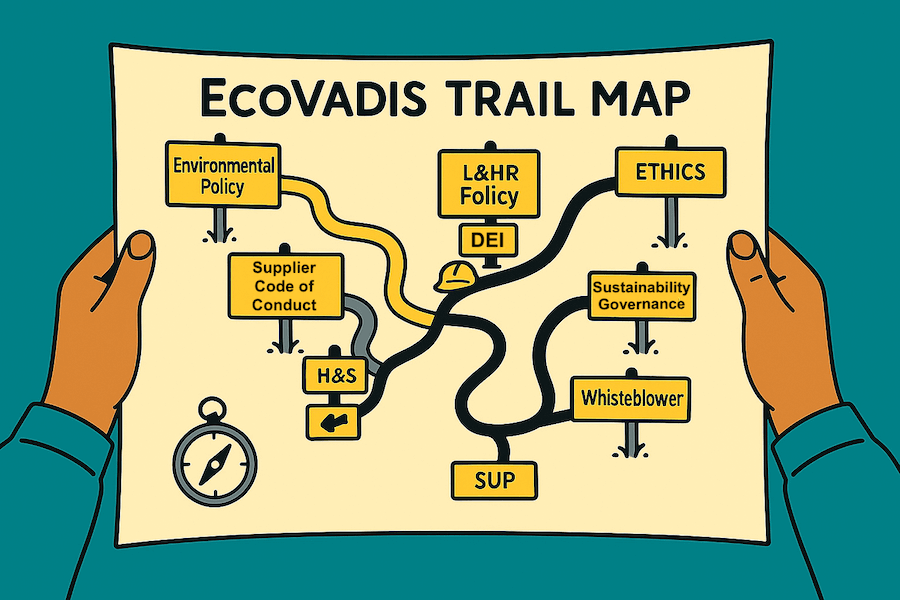
The 6 key EcoVadis policies are best understood as six practical foundation areas. Some areas may be covered by one document. Others may need a small set of supporting policies or codes, depending on your questionnaire, business model and activated criteria.
Feeling overwhelmed by the list? Start with the foundation areas most clearly linked to your questionnaire. If you need a structured starting point, the EcoVadis Policy Starter Kit includes six editable EcoVadis policy templates in Word and four practical guides. Every template still needs to be adapted to your company scope, owners, commitments and actual practices. For the broader evidence view beyond policies, use the EcoVadis required documents checklist .
Let’s break these down.
Policy, Code, Procedure or KPI: What Are You Uploading?
A lot of EcoVadis evidence confusion starts here. A policy, a code, a procedure and a KPI are different types of evidence. They can support each other. They prove different things.
This is why a policy foundation is useful. It is still only one layer. Your policy says what you commit to. The rest of your evidence shows whether the commitment is managed.
Does a Policy Count as Evidence of an EcoVadis Measure?
A policy can describe an action without proving that the action has actually been implemented. For example, a grievance policy may show that your company commits to providing a grievance mechanism. If the questionnaire asks which Measures are implemented, look for evidence that the mechanism operates in practice, such as a grievance procedure, employee communication or training, system records, or other implementation evidence that matches the questionnaire option.
Practical test: ask whether the document tells EcoVadis what your company intends to do, or whether it shows that you actually do it. Start with the exact questionnaire option and its Help Content. For the wider scoring logic, see the EcoVadis methodology guide.
What About Quantitative Targets in Policies?
Quantitative targets are an important part of policy robustness for some EcoVadis criteria. From April 2026, EcoVadis introduced more specific scorecard Improvement Areas that can flag the absence of quantitative targets within submitted policies for several Environment and Labour & Human Rights criteria.
That does not mean every policy needs every possible target. Use your activated criteria and the exact questionnaire Help Content. Only include a target your company has actually adopted and can track. A simpler true target is better than a stronger target that does not reflect your real management system.
If your company manages targets in a separate controlled KPI or target register because targets change more often than formally approved policies, that can make sense operationally. However, do not assume that a separate register will always replace a quantitative target expected in the submitted policy evidence. Where the questionnaire expects policy evidence to contain a target, the safer approach is for the submitted policy evidence itself to make that target clear.
Official reference: EcoVadis explains the 2026 policy-robustness feedback update in its Q1 2026 methodology update.
The public examples below are useful EcoVadis policy examples to study. Use them to understand what credible scope, commitments, ownership and targets can look like in real company documents. Then adapt your own policies to your company, rather than copying a generic template. The example targets in this guide are illustrations of target structure, not targets your company should adopt automatically.
What Belongs in an EcoVadis Environmental Policy?
- EcoVadis importance: An EcoVadis environmental policy addresses the Environment theme, including topics such as energy, GHG emissions, water, waste, pollution, materials and biodiversity where relevant.
- Essential components:
- Clear commitment to environmental protection, legal compliance and continuous improvement.
- Specific objectives for material environmental topics, such as energy, water, waste or emissions, with quantitative targets where they are relevant to the questionnaire and genuinely adopted by your company.
- Assigned roles and responsibilities.
- Commitment to regular review and top management endorsement.
- ”EcoVadis in Reverse” example: Waaree Energies’ Environmental Policy (DOC-WEL-POL-01) is a public example, detailing commitments and specific 2025 and 2030 targets across energy efficiency, air pollution, waste, carbon emissions, water and more.
For the full evidence chain beyond the policy layer, read Improve Your EcoVadis Environment Score.
📌 Quick Tip
Start with a general commitment and identify your top 2 or 3 environmental impacts. Where a quantitative target is relevant, use a target your company has actually adopted and can track. Strong target wording normally makes the metric, scope, deadline and baseline clear where a baseline is meaningful.
For example: ”We will reduce our Scope 1 and 2 greenhouse gas emissions by 15% by 2028, against a 2024 baseline.”
What Belongs in an EcoVadis Labour and Human Rights Policy Stack?
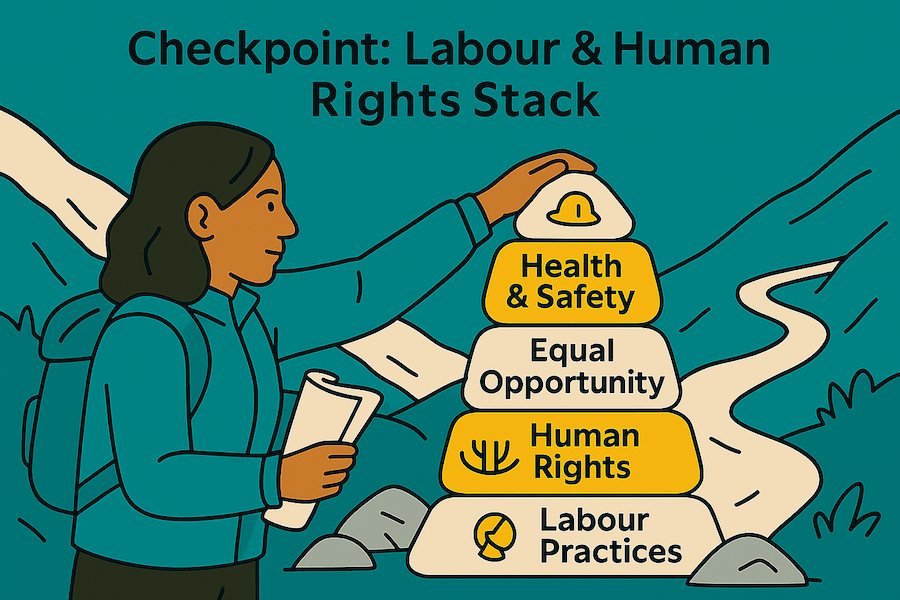
This theme often needs a small stack of connected policies. An EcoVadis labour and human rights policy can act as the umbrella, while Health and Safety, Equal Opportunity and Speak-Up documents add depth where they are relevant.
For the full theme view across policies, actions, KPIs, health and safety, employee voice and human rights evidence, read Improve Your EcoVadis Labour and Human Rights Score.
Comprehensive L&HR Policy (Umbrella)
- EcoVadis importance: Provides an overarching framework for worker well-being, human rights and fair employment practices.
- Essential components:
- Commitment to international standards, such as the ILO Core Conventions and UN Guiding Principles.
- Coverage of working conditions, social dialogue, career management, health and safety, prohibition of child labour and forced labour, and equal opportunity where relevant.
- Accessible grievance or concern-handling mechanisms.
- ”EcoVadis in Reverse” example: FineToday Group’s Human Rights Policy aligns with UN Guiding Principles and covers their value chain.
📌 Quick Tip
Use this as a parent document. Reference more detailed Health and Safety, Equal Opportunity or Speak-Up policies where they exist. When setting goals, aim for measurable targets that your company can realistically track.
For example: ”We will increase employee satisfaction scores by 10% by the end of 2026, as measured by our annual employee survey.”
Robust Health & Safety (H&S) Policy
- EcoVadis importance: Shows how your company manages workplace safety, accident prevention and operational health and safety risks.
- Essential components:
- Commitment to a safe workplace and accident prevention.
- Process for risk assessment and hazard control.
- Emergency preparedness procedures.
- Incident reporting and investigation.
- Employee training and consultation on health and safety.
- ”EcoVadis in Reverse” example: Gerresheimer AG demonstrates a target-driven approach to Health and Safety through its Group Occupational Safety Policy, an 80% Lost Time Incident Rate (LTIR) reduction target by 2028, and a commitment to ISO 45001 certification across production sites.
📌 Quick Tip
Use a recognised management-system structure where relevant, such as ISO 45001, then keep the wording matched to your real operations.
For example: ”We will reduce our Lost Time Incident Rate (LTIR) by 20% by the end of 2027, compared to our 2024 baseline.”
Effective Equal Opportunity Policy
- EcoVadis importance: Demonstrates commitment to non-discrimination, fairness and an inclusive workplace.
- Essential components:
- Clear prohibition of discrimination and harassment, with protected characteristics listed for your context.
- Commitment to equal opportunities in recruitment, promotion, pay and development.
- Confidential grievance channels for discrimination or harassment concerns, with non-retaliation clauses.
- ”EcoVadis in Reverse” example: Scott Bader demonstrates leadership here as one of the first ISO 30415 certificate holders for diversity and inclusion, alongside a public UK Gender Pay Gap Report.
📌 Quick Tip
List the prohibited grounds for discrimination that matter in your region and workforce. Add a measurable objective only if your company can actually support it with action and reporting.
For example: ”We will increase the representation of underrepresented groups in leadership positions by 15% by 2028.”
What Policies Form a Strong EcoVadis Code of Conduct and Ethics Framework?
Ethics is foundational to trust. For EcoVadis, this area usually needs a broad EcoVadis code of conduct, Code of Ethics or Code of Business Conduct, with supporting policies for anti-corruption, whistleblowing and responsible information management where relevant.
For the full theme view across anti-corruption, whistleblowing, responsible information management, controls, KPIs and evidence, read Improve Your EcoVadis Ethics Score.
Overarching Code of Ethics / Business Conduct
- EcoVadis importance: Sets the overall ethical tone and guiding principles for the organisation.
- Essential components:
- CEO or leadership message emphasising commitment to integrity.
- Core company values, such as honesty, fairness and respect.
- Compliance with laws.
- Guidelines on conflicts of interest, fair dealing and use of company assets.
- Summary of anti-corruption, data protection and whistleblowing principles, with links to specific policies where relevant.
- ”EcoVadis in Reverse” example: FineToday Group’s Code of Conduct and Ethics is comprehensive, available in multiple languages, signed by the CEO and organised around the company’s relationship with key stakeholders.
📌 Quick Tip
Use the Code of Ethics as the umbrella document. It can introduce more specific ethics policies and show that senior management owns the tone from the top.
For example: ”We will achieve 100% completion of annual ethics training by all employees by December 31 each year.”
Specific Anti-Corruption Policy
- EcoVadis importance: Addresses bribery, fraud, improper payments and other corruption risks.
- Essential components:
- Clear statement on bribery and corruption.
- Definitions of bribery, facilitation payments, gifts and hospitality.
- Rules for gifts, hospitality and third-party interactions.
- Due diligence expectations for relevant third parties.
- Commitment to accurate books and records.
- ”EcoVadis in Reverse” example: Ansell Limited’s Anti-Bribery & Corruption Policy reinforces their stance by prohibiting kickbacks, improper payments and facilitation payments. The document is publicly accessible on Ansell’s Governance webpage.
📌 Quick Tip
Be clear about gifts, hospitality, facilitation payments and third-party risks. Then connect the policy to training, approval rules or due diligence records.
For example: ”We will conduct annual anti-corruption training for 100% of relevant employees and achieve a 95% understanding score on post-training assessments.”
Clear Whistleblower Policy
- EcoVadis importance: Shows that employees and other stakeholders can report misconduct safely and that the company has a process for handling concerns.
- Essential components:
- Encouragement to report suspected wrongdoing.
- Multiple, accessible and confidential reporting channels.
- Explicit non-retaliation commitment.
- Outline of the investigation and follow-up process.
- ”EcoVadis in Reverse” example: Scott Bader’s Group Whistleblowing Policy is a clear, publicly available document detailing the reporting process and use of an external hotline.
📌 Quick Tip
Make the non-retaliation commitment easy to find. If anonymous reporting is available, say how people can use it.
For example: ”We will ensure all reported whistleblower concerns are reviewed within 30 days of receipt.”
Essential Data Protection / Information Security Policy
- EcoVadis importance: Supports responsible information management, especially where personal data, customer data, confidential information or cyber-security risks are relevant.
- Essential components:
- Commitment to confidentiality, integrity and availability of data.
- Compliance with relevant privacy and data protection laws, such as GDPR where applicable.
- Principles for access control and secure data handling.
- Information-security incident management.
- Employee training on data security and privacy.
- ”EcoVadis in Reverse” example: ZTE Corporation’s Business Code of Conduct addresses data security, privacy and intellectual property. ZTE also shows the wider management-system layer through its ISO 27001 and ISO 27701 certifications.
📌 Quick Tip
Keep this policy realistic. Avoid claiming mature information-security systems if the company only has basic controls. Match the wording to what you can support.
For example: ”We will complete annual privacy and information-security awareness training for all employees with access to personal or confidential data.”
Why is an EcoVadis Supplier Code of Conduct Essential?
An EcoVadis supplier code of conduct is one of the most useful documents in the Sustainable Procurement theme because it translates your sustainability expectations into supplier-facing rules.
For the full theme view across supplier policy, screening, contract clauses, supplier engagement, audits, KPIs and coverage, read Improve Your EcoVadis Sustainable Procurement Score.
- EcoVadis importance: Defines your company’s expectations for supplier environmental, social and ethical performance, and can support evidence that you are managing sustainability issues in the supply chain.
- Essential components:
- Supplier expectations: Environmental management, labour and human rights, health and safety, business ethics, anti-corruption, data protection and responsible sourcing.
- Requirements for suppliers to acknowledge or sign the code.
- Process for supplier selection or evaluation that considers sustainability.
- Commitment to supplier engagement, development or verification where relevant.
- Consequences or escalation process where expectations are not met.
- ”EcoVadis in Reverse” example: Verescence’s Supplier CSR Charter shows expectations across sustainability themes, mechanisms for enforcement and verification, and cascading requirements through the supply chain. Verescence also reports 100% strategic supplier sign-off and supplier EcoVadis participation in its sustainability report.
📌 Quick Tip
Make your Supplier Code of Conduct a living document. Connect it to supplier onboarding, contracts, purchasing decisions and supplier follow-up.
For example: ”We will ensure 80% of our tier-1 suppliers have signed and committed to our Supplier Code of Conduct by the end of 2027.”
Beyond the First Six: Supporting Policies That May Matter
The first six foundation areas give you the map. Some companies then need a more detailed policy system underneath it. This is where the work becomes more specific to your business model and questionnaire.
This is why I would avoid treating any public list as a universal rule. Your policy foundation should follow the questionnaire, your material risks and what the assessed entity actually does.
How Can We Create Effective Policies Quickly?
- Use a standard structure: For each policy, include title, purpose, scope, definitions where needed, commitments, roles and responsibilities, implementation mechanisms, training and communication, monitoring and review, version control and top management endorsement.
- Focus on activated criteria: Review your EcoVadis questionnaire to see which criteria are relevant for your company. Prioritise detailed policy content for these areas.
- Use existing materials carefully: If you have informal guidelines or procedures, formalise them. If you use EcoVadis policy templates or other EcoVadis templates, customise them thoroughly to reflect your company risks, operations, owners and commitments.
- Check the evidence fit before upload: Ask whether the document applies to the assessed scope, is current, has a real owner, is approved and connects to actions or results.
- Plan communication: Decide how each policy will be communicated internally or to suppliers. This helps you build Action evidence later.
Policy fit check before you upload
- Does the policy apply to the assessed entity and scope?
- Is it relevant to an activated criterion or real business risk?
- Is it dated, version-controlled and reviewed?
- Is it approved or endorsed by management?
- Does it name owners, responsibilities or governance arrangements?
- Where relevant to the questionnaire, does it include quantitative targets your company has actually adopted and can track?
- Does it connect to actions, records, training, controls, KPIs or reporting?
📝 Key Takeaways
- Think in foundation areas: The six policy foundations are a practical starting map. Your questionnaire, scope and business model decide which documents matter most.
- Use the questionnaire: Your activated criteria, scope, industry, locations and business model should decide which policy content matters most.
- Customise templates: EcoVadis policy templates can save time. The final wording needs to reflect your actual risks, commitments and practices.
- Connect Policies to Actions and Results: A policy is stronger when you can also show implementation, coverage or reporting evidence.
Related Reading & Resources
Use these next if you need to move from policy wording into scoring logic, evidence planning or document quality.
- EcoVadis Methodology Explained: understand how Policies, Actions and Results fit into scoring.
- EcoVadis Required Documents Checklist: use this when you need the broader evidence view beyond policies.
- Finding and Fixing EcoVadis Evidence Gaps: check whether your policy evidence connects to the questionnaire and the assessed scope.
- EcoVadis Documents Not Accepted: understand why documents can fail even when the topic looks relevant.
- EcoVadis Assessment Guide: use this if you need the full assessment overview.
Need a faster policy foundation?
You now have the policy foundation areas. Writing the documents from scratch still takes time. The EcoVadis Policy Starter Kit gives you ready-to-customise EcoVadis policy templates and guidance to help you draft practical first versions, assign owners and prepare clearer evidence before submission.
EcoVadis Policy FAQ
Why are policies a crucial starting point for an EcoVadis assessment?
Policies show your company's commitments, scope, ownership and governance. They support the Policies part of EcoVadis' management-system logic. They also need to be backed by actions, coverage, reporting and other evidence.
What are the six EcoVadis policy foundation areas?
A practical starting point is Environment; Labour and Human Rights; Health, Safety and Equal Opportunity; Ethics and Business Conduct; Anti-Corruption, Speak-Up and Responsible Information Management; and Sustainable Procurement and Supplier Expectations.
Can I use EcoVadis policy templates or EcoVadis templates?
Yes, EcoVadis policy templates can help with structure. The important part is customisation. Adapt the wording to your assessed scope, actual responsibilities, real risks, company commitments and evidence you can support.
What makes a policy credible for EcoVadis?
A credible policy is relevant to the assessed entity and activated criteria, clearly attributable to the company, has an issue, approval or effective date and review information, is approved or endorsed by management, is clear about responsibilities, and connects to actions, controls or reporting evidence.
Does a policy count as evidence of an EcoVadis Measure?
A policy can describe a measure, but it does not automatically prove that the measure has been implemented. If the questionnaire asks for Measures, use evidence that shows the action operates in practice, such as procedures, training records, completed assessments, system records or other implementation evidence relevant to the option.
Do EcoVadis policies need quantitative targets?
Quantitative targets are a policy-robustness factor for some EcoVadis criteria, but the requirement is not identical for every policy or company. Check your activated criteria and questionnaire Help Content. Only include targets your company has genuinely adopted and can track.
Is a Supplier Code of Conduct the same as a Sustainable Procurement Policy?
No. A Supplier Code of Conduct is the supplier-facing rulebook. A Sustainable Procurement Policy usually explains how your company manages supplier selection, evaluation, engagement and sourcing decisions.
About Double Your Sustainability
Rutger founded Double Your Sustainability to help companies work through EcoVadis assessments with more clarity and less wasted effort. He draws on 15 years of corporate sustainability experience, direct lessons learned from achieving EcoVadis Platinum medals, and practical client work helping companies prepare submissions, review evidence and understand scorecards.
As a certified EcoVadis Solutions Practitioner with an MSc. in Strategic Sustainable Development, his focus is on turning sustainability work into clearer evidence, better decisions and scorecards you can interpret and act on.